
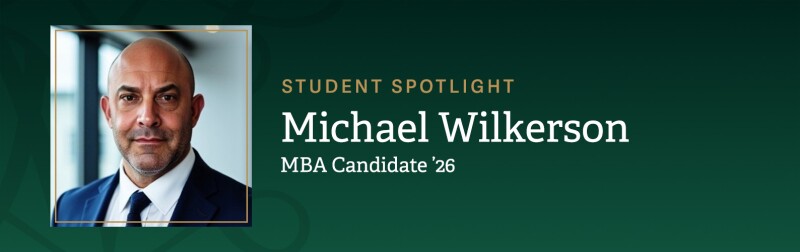
For years, Michael Wilkerson kept hearing the same thing. He was running businesses, managing teams, closing deals—doing, by every measure, the work of a CEO. But when it came to the title itself? “If you had an MBA, this would be a no-brainer,” he was told. Again and again.
It’s a frustrating thing to hear when you have two decades of real-world results behind you. But Wilkerson, a private equity veteran with more than 20 years of experience who currently serves as executive vice president, general manager and shareholder of a privately owned business, decided to stop being frustrated and start doing something about it.
“I decided that it was time to invest in myself and get an MBA,” he said.
The Program That Fit Around a 60-Hour Work Week
The decision to go back to school wasn’t simple for someone working 60 to 70 hours a week. Wilkerson needed a program that wouldn’t ask him to choose between his education and the business he was responsible for running. When he found the William & Mary Online MBA at the Raymond A. Mason School of Business, the fit was immediate. The asynchronous format, which allows students to complete coursework on their own schedule rather than logging in at a fixed time, was appealing to his schedule and needs.
But flexibility wasn’t the only draw. Wilkerson had done his research and narrowed his choices to five programs. William & Mary sat at the top of the list as a school he placed in the same conversation as Ivy League institutions. “Typically, you get that reputation for a reason,” he noted.
When the Assignment Is Your Actual Business Problem
What Wilkerson didn’t fully anticipate was just how directly the curriculum would collide with the hardest problems he was already facing at work.
At the center of William & Mary’s Online MBA is a signature framework—the “wicked problem.” Built on the idea that the most consequential business challenges don’t have clean, singular answers, the wicked problem asks students to identify a complex, high-stakes issue from their own professional lives and return to it across every course, letting each discipline, from finance to marketing to operations, inform and pressure-test their thinking. As Wilkerson described it: “It’s a really difficult problem that has thousands of potential answers… and any answer that you choose may be right, but that answer is going to lead you down a path that’s probably going to open up a whole other can of problems as well.”
For Wilkerson, the choice of problem was straightforward. His company sources products from manufacturers across Asia for furniture makers and cabinet builders. With geopolitical tensions rising and supply chain risk mounting, he recognized an urgent need to diversify—to find new manufacturing partners in new countries before the ground shifted beneath him.
Then the tariffs hit.
Midway through the program, sweeping new trade policies rewrote the landscape Wilkerson had been analyzing. A wicked problem, almost by definition, had gotten wickeder. “I had to pivot again,” he said. “What’s cool about that is, I was able to live it while I was working through it.”
That’s not something a textbook can manufacture.
One Student’s Wicked Problem
Video Transcript
And so it has, you know, that’s a big kind of lever and stress on our business. And so I decided to make my wicked problem that was diversifying our partnerships overseas, finding other countries to go to. What was funny about that is in the beginning of the course structure and as I was going through, about halfway through after this administration was elected and they decided to tariff every country, it kind of had to change my wicked problem.
So I had to pivot again. And so what’s cool about that, I think, is what’s a wicked problem? It’s a really difficult problem that has thousands of potential answers that any answer that you choose could be right or maybe be right, but that answer is gonna lead you down a path that’s probably gonna open up a whole another can of problems as well.
So it did that. It did just that. And so I was able to live it while I was working through it. And each course sort of touches on it in their own way. So it’s introduced in the Renaissance program, and so you kind of talk about it and build something, and then you’re always free to kind of change it or sort of, I guess, bake it and mature it. But yeah, at some point now, actually just finishing finance, and I’m kind of going through and looking at costs and looking at these things, there’s a bit of a change in my wicked problem. I’m just coming into this, I guess, capstone project, I guess you would call it, which is final class, where we have to formally kind of do it.
I think I’m gonna throw a wrinkle in it. I think it’s going to be a kind of a different reveal at the end than I thought it was gonna be, and I’m excited about that.
Finding Value in Every Course
As Wilkerson moved through courses in finance, accounting and economics, subjects he wasn’t sure he’d enjoy, he found that each one handed him new tools to apply to his evolving challenge in real time. The unexpected happened, too: he loved them. “I ended up loving them and doing well, because you learn so much,” he said. “People get scared that you’re going to have to drink through a fire hose. But that’s not the case.”
Now approaching the program’s capstone, where students formally synthesize their wicked problem work, Wilkerson is already planning a twist. “It’s gonna be kind of a different reveal at the end than I thought it was going to be,” he said, “and I’m excited about that.”
Advice to Anyone Considering the Leap
For prospective students weighing whether an online MBA is worth the investment, Wilkerson’s advice is equal parts honest and encouraging.
“You’re going to put 20 hours a week into this program, whether you think you are or not,” he said. “It’s a master’s program. You get what you pay for.” But the return, he added, is real—if you show up for it. “Be present in each course and be intentional in each course and really try to experience everything that you can, because it will be rewarding.”
For a private equity executive who spent years being told he was one credential short of the title he’d already earned, that reward is no longer hypothetical.
Achieve More With William & Mary’s Online MBA
Interested in learning how the William & Mary Online MBA could work for your career? Discover how the program can help you achieve your goals while balancing your current career.
Gain valuable skills that can lead to expanded job opportunities and career advancement. The comprehensive curriculum develops hard and soft skills essential for success in the business world, preparing you to address complex business challenges across various industries. Choose from nine cutting-edge specializations that let you craft an educational journey as distinctive as your professional goals.
To learn more about William & Mary’s Online MBA program, review the admissions information and schedule a call with one of our helpful admissions outreach advisors.